
ADHD & Executive Functioning Worksheets
Printable planners, dopamine menus, and micro-sprint canvases designed for neurodivergent focus.
Clinical Principle: Externalize working memory & bypass dopamine paralysis.
The ADHD brain struggles with time blindness and task initiation. These behavioral scaffolding tools act as an external prefrontal prosthetic, breaking open-ended study blocks into tangible, low-friction micro-sprints.
Which Worksheet Do You Need Right Now?
Match your immediate academic or emotional friction point to the corresponding clinical tool.
| Immediate Situation / Challenge | Recommended Tool | Time | Core Mechanism | Action |
|---|---|---|---|---|
| Staring at books for hours without initiating work | ADHD Daily Focus & Reset Planner | 15 min | Prefrontal offloading, single-task constraint, and 2-minute somatic warmup ritual. | View |
| Getting trapped in 2-hour doom-scrolling loops during 5-minute study breaks | ADHD Dopamine Menu & Energy Restorer | 10 min | Categorizes healthy stimulation into quick appetizers and focus sides, keeping phone away. | View |
| Massive 20-chapter board exam syllabus causing total freeze and paralysis | Task Chunking & Micro-Sprint Canvas | 12 min | Reverse-engineers monster academic topics into 10-minute conquerable sprint units. | View |
| Need a comprehensive multi-week system rather than single daily sprint sheets | The ADHD Adolescent Executive Functioning Workbook (18 Pages) | 14-Day Protocol | Structured 4-module protocol with dopamine menus, monotask sprints, syllabus chunking, and exam panic resets. | View |
The ADHD Adolescent Executive Functioning Workbook
A 14-day clinical roadmap to master task initiation, regulate dopamine loops, and defeat exam paralysis.
All Worksheets in This Collection
Download the publication-grade A4 vector PDF or open interactive step-by-step instructions.
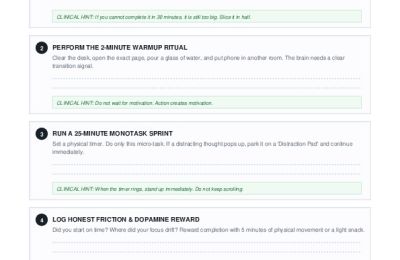
ADHD Daily Focus & Reset Planner
Estimate task duration, chunk steps, and protect study blocks from dopamine traps.
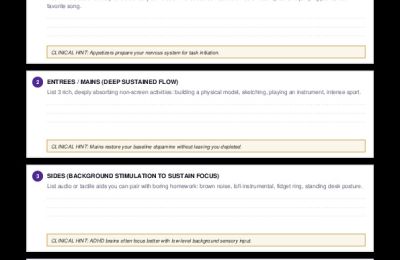
ADHD Dopamine Menu & Energy Restorer
Replace doom-scrolling with quick appetizers, deep mains, and gentle sides.
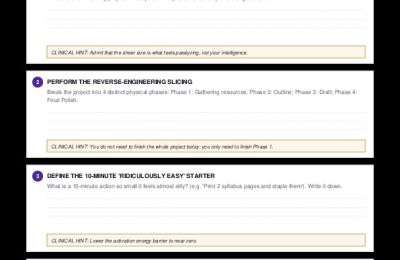
Task Chunking & Micro-Sprint Canvas
Break down overwhelming multi-chapter syllabi into 10-minute conquerable units.
How to Sequence This Toolkit
These worksheets are designed to be used sequentially as a coherent intervention, rather than isolated sheets.
Slice Intimidating Syllabi into Micro-Units
Start with the Task Chunking Canvas whenever a massive chapter or multi-subject exam schedule feels impossible. Deconstruct large goals into 10-minute starter chunks.
Anchor Your Single Focus Block & Warmup
Complete the ADHD Daily Focus & Reset Planner immediately before sitting down at your desk. Execute the 2-minute physical warmup ritual and commit to one single task.
Protect Study Breaks from Algorithmic Rabbit Holes
Keep the ADHD Dopamine Menu visible next to your study area. When your 25-minute sprint ends, choose a physical 'Appetizer' or 'Side' instead of picking up a smartphone.
Understanding the Cognitive Challenge
What Students & Families Need to Know
ADHD in teenagers is fundamentally an executive performance bottleneck, not a deficit of knowledge. Adolescents with ADHD usually know exactly what syllabus they need to finish; the neurological challenge lies in initiating, sequencing, and sustaining focused effort at the point of performance. When faced with unstructured revision time or heavy board exam syllabi (CBSE, ICSE, State Boards), the prefrontal cortex experiences severe friction, often misinterpreted by parents and teachers as laziness, lack of willpower, or defiance.
Why Traditional Planners & Advice Fail
Standard to-do lists and study timetables fail because they demand intact working memory, internal motivation, and continuous temporal estimation. For a neurodivergent brain with dysregulated dopamine tone, writing 'Study Chemistry for 3 hours' is cognitively overwhelming—it lacks an observable physical start line, provides zero immediate neurochemical reinforcement, and triggers acute executive avoidance.
The Behavioral Scaffolding Mechanism
Behavioral scaffolding externalizes the prefrontal cortex. By constraining task horizons to sub-25-minute observable units, offloading intrusive thoughts onto an external physical parking pad, and pre-planning somatic dopamine restoration rituals, these worksheets drastically lower the activation energy required to initiate work.
Guidelines for Parents & Educators
How to introduce these tools collaboratively without triggering power struggles or resistance.
What Helps (Supportive Practices)
- •Praise the initiation of study (starting the physical timer at 6 PM), not just test scores 3 weeks later.
- •Provide a dedicated analog visual timer or magnetic cube timer rather than a smartphone screen.
- •Offer a small protein or fruit snack and cold water before revision to support sustained attention.
What to Avoid (Common Pitfalls)
- •Do not enter the study room unannounced every 15 minutes to ask 'How much syllabus is left?'.
- •Never moralize distraction; treat attention slips as cognitive friction data, not moral failure.
- •Avoid vague commands like 'Go study'—collaborate on an exact, observable deliverable instead.
Common Questions About These ADHD & Executive Functioning Worksheets
Do ADHD worksheets replace medical treatment or clinical therapy?
No. Worksheets provide essential behavioral scaffolding and executive functioning skill-building. In clinical practice, medical management optimizes neural signaling while behavioral tools build the daily routines and external scaffolding required for lifelong academic independence.
At what age should a student begin using these ADHD worksheets?
These tools are designed for secondary and senior school students aged 13 to 19 (Class 8 through College). For younger adolescents (13–15), we strongly recommend parents co-fill the first 2 sessions collaboratively before transitioning to independent use.
How often should my teenager fill out the focus planner?
Use it once per evening study block or weekend revision session. Completing it daily for 21 consecutive days establishes an automated startup ritual that substantially reduces study resistance.
Learning Intelligence & Executive Function Explorer
Identify your teen's unique cognitive processing profile, executive friction points, and focus stamina with our validated assessment.
Explore Other Curated Topic Hubs
Anxiety, Exam Panic & Social Confidence Worksheets
CBT cognitive restructuring, panic resets, and exposure hierarchy ladders for teens and students.
Parent-Teen Communication & Boundary Worksheets
Co-created agreements, conflict repair scripts, and emotional validation guides for families.
Stream Selection & Career Decision Worksheets
Objective decision matrices and cognitive stamina audits for Class 10 and 12 students.
Stress Management & Sleep Reset Worksheets
CBT stimulus control, worry windows, and somatic resets for overwhelmed students.