
Parent-Teen Communication & Boundary Worksheets
Co-created agreements, conflict repair scripts, and emotional validation guides for families.
Clinical Principle: Shift from reactive policing to collaborative connection.
Adolescent individuation often leads to household friction and shutdown. These worksheets provide neutral, non-defensive scripts and collaborative frameworks that protect the parent-teen relationship while maintaining firm boundaries.
Which Worksheet Do You Need Right Now?
Match your immediate academic or emotional friction point to the corresponding clinical tool.
| Immediate Situation / Challenge | Recommended Tool | Time | Core Mechanism | Action |
|---|---|---|---|---|
| Teen screaming, door slamming, or totally shutting down during conversations | The 3-Step Emotional Validation Script | 8 min | Regulates emotional spikes by acknowledging feelings before discussing solutions. | View |
| Lingering cold war, resentment, or heavy silence after a major fight | Parent-Teen Communication & Conflict Repair Script | 15 min | Facilitates structured, non-defensive reflective listening based on family systems therapy. | View |
| Daily household warfare over smartphone use, social media, and gaming hours | Collaborative Family Screen-Time Agreement | 20 min | Builds a bilateral agreement with clear device-free sanctuaries and automatic consequences. | View |
All Worksheets in This Collection
Download the publication-grade A4 vector PDF or open interactive step-by-step instructions.
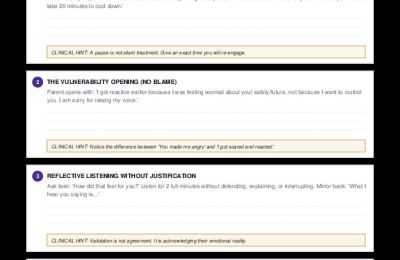
Parent-Teen Communication & Conflict Repair Script
De-escalate power struggles and repair emotional disconnect without defensiveness.
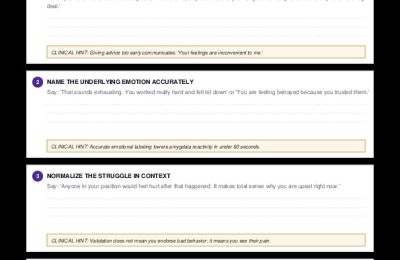
The 3-Step Emotional Validation Script
De-escalate teen emotional meltdowns by validating feelings before offering solutions.
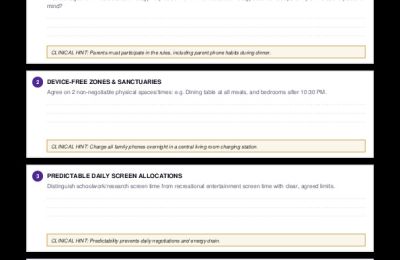
Collaborative Family Screen-Time Agreement
Co-created digital wellness rules for parents and teens without daily arguments.
How to Sequence This Toolkit
These worksheets are designed to be used sequentially as a coherent intervention, rather than isolated sheets.
Validate Feelings Before Offering Fixes
Use the 3-Step Emotional Validation Script in everyday tense moments to resist the fix-it urge and name underlying emotions.
Repair Relationship Ruptures Post-Conflict
Use the Parent-Teen Conflict Repair Script 24 hours after a heated argument to de-escalate tension and formulate a joint micro-agreement.
Establish Transparent Family Digital Rules
Sit down together with the Collaborative Family Screen-Time Agreement to establish device-free zones and automatic, non-punitive boundaries.
Understanding the Cognitive Challenge
What Students & Families Need to Know
During the adolescent transition, the teenage brain undergoes rapid neural reorganization that prioritizes autonomy, peer status, and emotional intensity. What parents frequently interpret as disrespect, defiance, or stubbornness is often a clumsy attempt to exercise developmental agency. Shouting matches and reactive punishments trigger reciprocal defensiveness, prompting teenagers to retreat into silence or secretive behavior.
Why Traditional Planners & Advice Fail
Unilateral rules ('Hand over your phone right now, no arguments') trigger immediate defiance and covert digital use. Conversely, permissive parenting without consistent boundaries fosters anxiety and undisciplined screen habits. Both approaches fail because they exclude the teenager from the problem-solving process.
The Behavioral Scaffolding Mechanism
Collaborative problem-solving and emotional validation deactivate the limbic fight-or-flight response. When a teenager feels heard without immediate moralizing, their prefrontal cortex remains open, enabling authentic compromise and sustainable adherence to household agreements.
Guidelines for Parents & Educators
How to introduce these tools collaboratively without triggering power struggles or resistance.
What Helps (Supportive Practices)
- •Connect before you correct: ensure emotional safety before giving guidance.
- •Model digital wellness by keeping your own phone away from dining tables and bedrooms.
- •Involve your teenager in defining reasonable consequences so rules feel mutually agreed upon.
What to Avoid (Common Pitfalls)
- •Do not hold difficult family conversations while either party's heart rate is elevated above 100 bpm.
- •Never confiscate devices impulsively in anger; always refer back to pre-agreed contract clauses.
- •Avoid toxic generalities like 'You never listen' or 'You always make excuses'.
Common Questions About These Parent-Teen Communication & Boundary Worksheets
What if my teenager refuses to sign the Screen-Time Agreement?
Frame it as a household partnership rather than parental control: 'We both get distracted by notifications, so we need family guidelines that apply to all of us.' When teenagers see parents submitting to the same screen-free dinner table rules, resistance declines significantly.
How long after an argument should we use the Conflict Repair Script?
Wait between 2 and 24 hours. Attempting a repair conversation while adrenaline is still high will trigger re-escalation. Both nervous systems must return to physiological baseline first.
Parent-Teen Conflict Style & Communication Index
Understand your dominant conflict resolution mode and discover hidden triggers in your parent-teen communication patterns.
Explore Other Curated Topic Hubs
ADHD & Executive Functioning Worksheets
Printable planners, dopamine menus, and micro-sprint canvases designed for neurodivergent focus.
Anxiety, Exam Panic & Social Confidence Worksheets
CBT cognitive restructuring, panic resets, and exposure hierarchy ladders for teens and students.
Stream Selection & Career Decision Worksheets
Objective decision matrices and cognitive stamina audits for Class 10 and 12 students.
Stress Management & Sleep Reset Worksheets
CBT stimulus control, worry windows, and somatic resets for overwhelmed students.