
Parenting Styles, Boundaries & Spousal Alignment
Ending Good Cop / Bad Cop: When You and Your Spouse Parent From Opposite Trenches
One's the villain, one's the rescuer — and your teen has learned to play the gap better than either of you plays your part. Close the crack and the exploitation ends.
Co-Regulation & Attunement
Testing adult boundaries to verify that the parent remains calm, sturdy, and emotionally regulated when they spiral.
The Live Override
Every public countermand prices your spouse's authority at zero — and teaches appeals-court shopping.
"Mum and I decide together — answer in ten minutes."
"Father says no phone after 10. Teen walks to mother. Mother says 'just this once, he's tired' — in front of him."
"By next week he doesn't ask father anything anymore. Why would he? There's a faster counter, and she always approves. Father, meanwhile, has started enforcing harder to 'compensate' — and now he's the shouting villain in a house where mother is the beloved rescuer."
"The marriage argument that night isn't about the phone at all. It's the fifth one this month about 'you always undermine me' vs 'you're too harsh' — conducted in whispers so he doesn't hear, while he hears all of it through the wall."
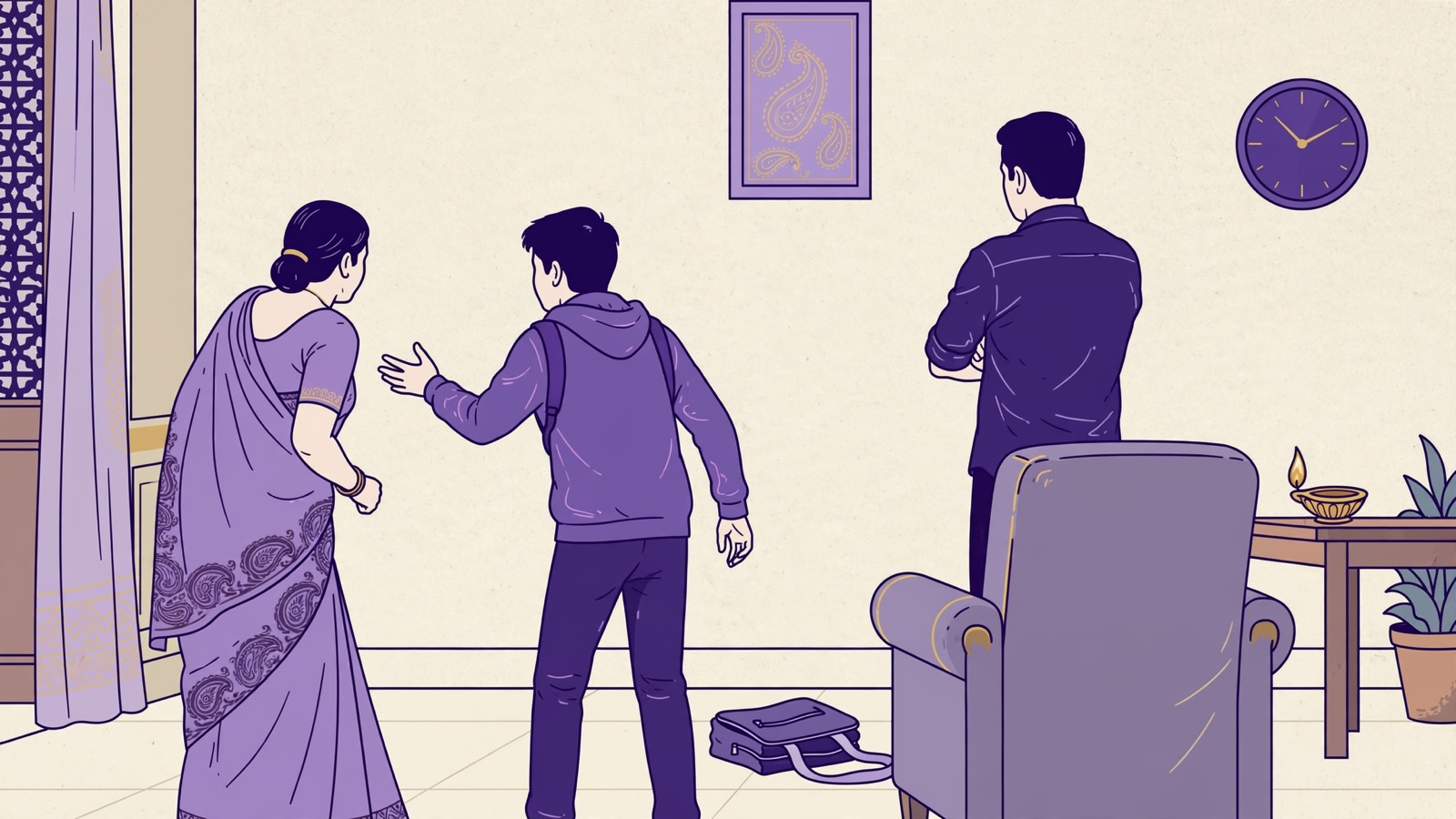
Neither of you is the problem and neither is the villain — the structure is. Two loving parents with different thresholds, no alignment ritual, and a brilliant teenage arbitrageur in the middle will produce exactly this split, every time, in every house. Close the crack and both uniforms dissolve within weeks.
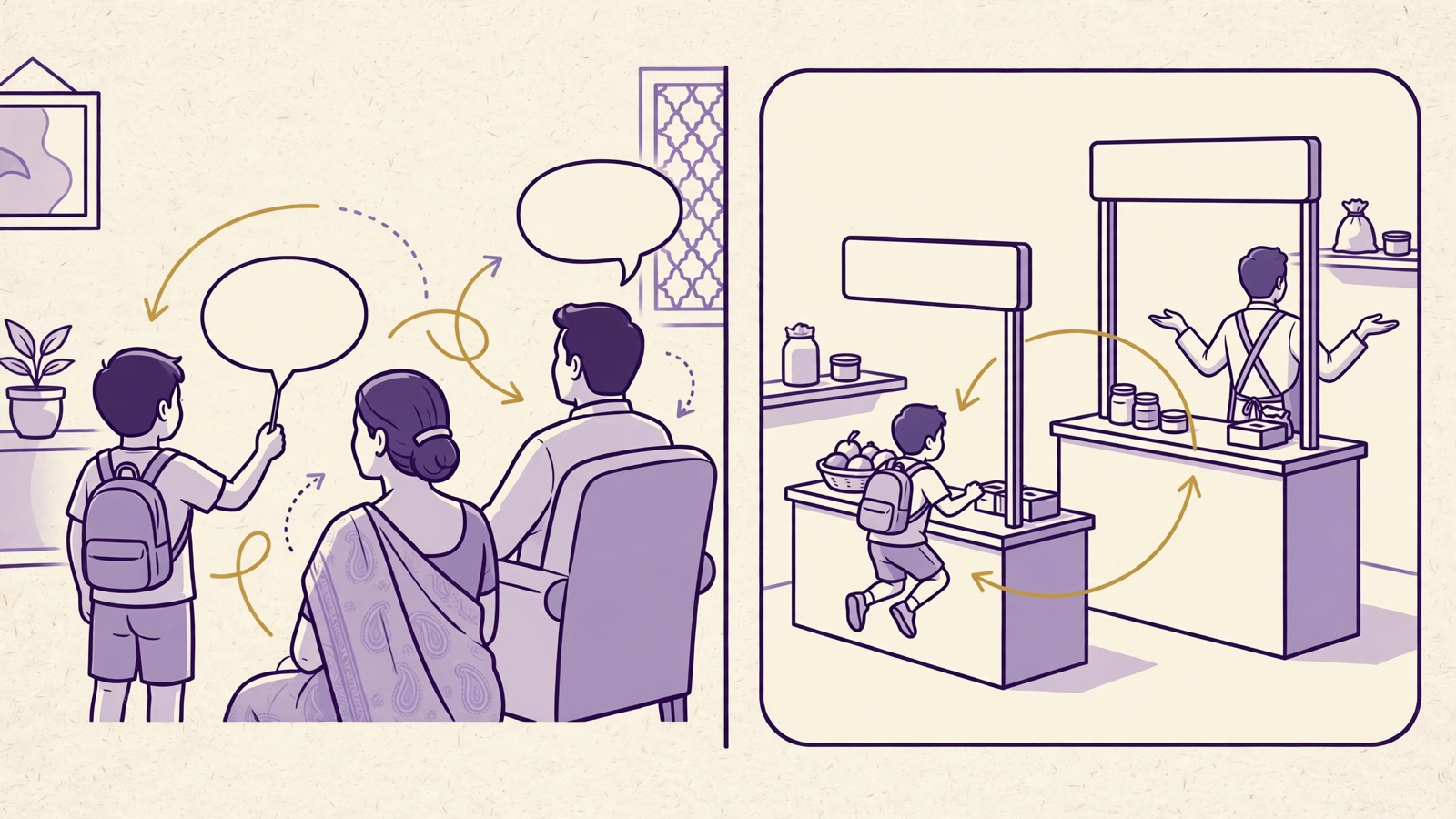
The Behavior Decoder
Translating what you see into what their nervous system is actually experiencing
"'Mum said I could!' deployed instantly against father's no — with mother's confirmation sought live"
Why accept the slower, stricter counter when a faster lenient one exists in the same house? This isn't manipulation — it's rational shopping.
"One parent escalates strictness to 'compensate' for the other's leniency — the villain/rescuer casting hardens"
The strict parent now performs strictness to balance the ledger; the lenient one performs rescue to keep the love. Both are acting, and he can see the costumes.
"Whisper-fights between parents after bedtime about undermining — audible through walls"
He hears the marriage strain and files it under 'my fault' or 'my weapon' — either way, parental unity becomes his leverage or his guilt.
Arbitrage, Not Manipulation: The Economics of the Crack
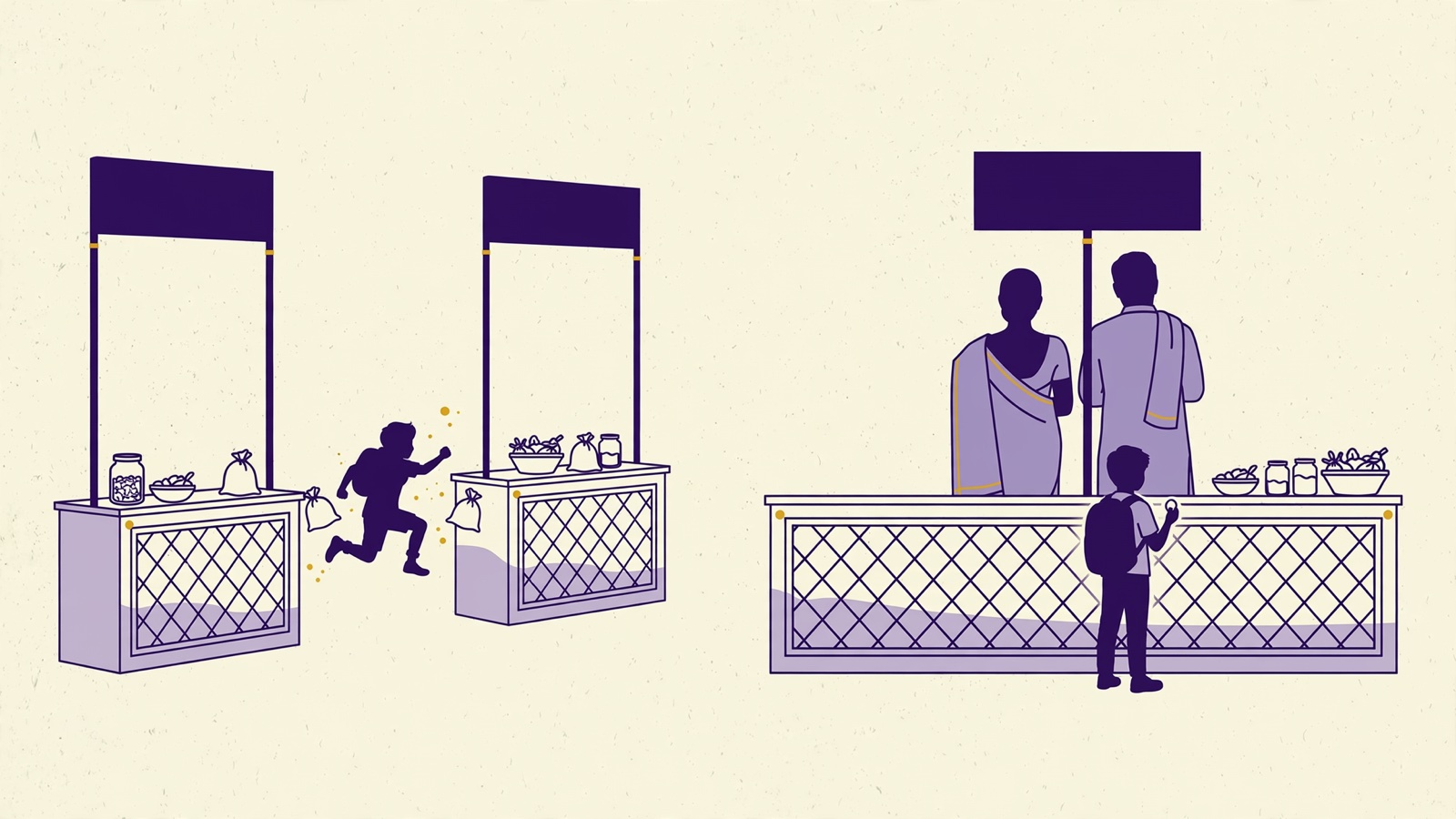
Adolescents are ruthless rationalists about household structure: two authorities with different prices will be shopped exactly like two shops with different prices. Psychologists call the mechanism 'splitting' — but the child isn't splitting out of malice; the system invites it by pricing the same behaviour differently at two counters. Meanwhile each parent's counter-behaviour is operant-conditioned by the teen's responses: strictness gets defiance (so strictness escalates), leniency gets affection (so leniency deepens). The loop locks both uniforms in place. The only exit is structural — one price, one counter — because no amount of willpower beats a standing arbitrage opportunity.
Natural Instincts That Accidentally Make It Worse
Every caring parent falls into these traps out of love, fear, or exhaustion. Here is what happens inside their nervous system and how to shift:

The Live Override
Countermanding your spouse in front of the teen: 'No no, he can go — you're being too strict.'
Publicly prices your spouse's authority at zero. Every future rule from them now routes through your appeals court — and the teen learns courts overrule cops.
Absolute rule: never override live. Swallow it, note it, raise it in the closed-door review. The marriage outranks the moment.
Role Fossilisation
Settling into permanent casting: strict father / soft mother, enforcer / friend, discipline / fun.
Fossilised roles starve both relationships: the villain never gets to be tender, the rescuer never gets to hold a line — and the teen loses one full parent.
Rotate consciously: the 'strict' one delivers the next piece of good news; the 'soft' one enforces the next boundary. Break the typecasting monthly.
The Whisper War
Nightly low-volume fights about parenting, conducted to 'protect' the teen from the disagreement.
Children read tension at far lower volumes than parents believe. Secret conflict teaches that disagreement is dangerous and must be hidden — the exact lesson you don't want modelled.
Scheduled, calm alignment reviews (Sunday 15 minutes, teen elsewhere) replace nightly whisper wars. Disagreement becomes administration, not warfare.
The Single-Counter Protocol
Merge the shops: one rule, one voice, with a private legislature behind it.
Declare the Merger (To Each Other First)
Name the pattern without blame, as co-CEOs fixing a pricing bug.
- Private conversation opener: 'We've built a two-counter house and he's shopping rationally. Neither of us is wrong; the structure is. Let's merge counters.'
- Agree the non-negotiable: no live overrides, ever, from either side. Write it down. Both sign (seriously — the ritual matters).
- Set the review slot: 15 minutes every Sunday, teen occupied elsewhere. This replaces all ad-hoc parenting fights.
Build the Shared Rulebook (10 Rules Max)
Few rules, identically enforced, visibly posted.
- List only what actually matters (screens, sleep, study minimums, respect baseline, safety). Ten max — everything else is negotiable territory.
- Each rule gets the same consequence from both parents, written next to it. No improvisation at enforcement time.
- Post it on the fridge. A posted rule is institutional; an announced rule is personal.
Install the Deferral Phrase
A single sentence that buys alignment time in front of the teen.
- When caught off-guard: 'Your mother and I decide together — answer in ten minutes.' Then actually confer, even for two minutes.
- Both parents use the identical phrase. The teen hears one institution, not two people stalling.
- Never break the ten-minute promise — deferral without delivery is just a slower no, and he'll price it accordingly.
De-role Monthly (Break the Casting)
Actively rotate who plays which part.
- Each month, swap one signature move: the enforcer plans the fun outing; the rescuer holds the week's hardest boundary.
- Name it lightly to the teen: 'Dad's on fun duty this month, I'm on rules — don't get used to it.' Humour dissolves the fossil.
- Review in the Sunday slot: is the arbitrage closing? Teen testing usually spikes week one (extinction burst) then collapses.
What to Say Tonight: Word-for-Word Scripts
Save these to your phone or keep them in mind for your next interaction.
"'Mum and I decide together — answer in ten minutes.' (Then confer, decide once, deliver jointly: 'We've talked — here's the decision, from both of us.')"
Calm, unhurried, zero irritation at the tactic itself.
Refuses the arbitrage without punishing the shopper, and the joint delivery proves the merger is real, not threatened.
"'I'm not saying you're too soft or I'm too strict — I'm saying we've built two counters and he's shopping. I want us to be one shop with one price list. Will you build the rulebook with me this Sunday — fifteen minutes?'"
Private, seated, no teen in earshot. Co-CEO energy, zero prosecution.
Frames the fix as structural (no villain), proposes a tiny bounded commitment, and recruits rather than accuses.
"(Support it fully in the moment.) Later, privately: 'I backed your call fully out there. For next time — I'd have gone the other way because X. Can we set the default for that situation in the rulebook?'"
Public loyalty, private candour. In that order, always.
Protects the single counter in real time while keeping the legislature honest — disagreement flows upward, never sideways through the teen.
Merge the shops: disagree in private, present one front, retire both uniforms.
Calm, unhurried, zero irritation at the tactic itself
"Mum and I decide together — answer in ten minutes."
The Underlying Psychological Mechanics
Why Splitting Is Rational (and Therefore Inevitable)
This reframe also dissolves the blame loop: the lenient parent isn't 'weak', the strict one isn't 'harsh' — both are rational responses to the teen's differential demand. Fix demand (one price), and both supply behaviours relax on their own.
The Extinction Burst Warning
Warn each other in advance ('week one will be loud'), hold every line that week, and watch week three: testing collapses once the market genuinely closes. Couples who don't expect the burst usually reopen a counter in week one — and teach that persistence reopens markets.
Culture Note: The Extended Legislature
All Situations in Parenting Styles, Boundaries & Spousal Alignment
Connect Before You Direct (The Golden Rule)
Why barking commands triggers biological resistance, and how a 2-minute connection ritual unlocks voluntary cooperation.
Anger Isn't the Problem — Reactivity Is
How to harness anger constructively to hold firm boundaries without shouting, sarcasm, or silent treatments.
When Spouses Disagree: Ending Good Cop / Bad Cop
How divided parental rules cause teens to manipulate boundaries, and how to create a unified front behind closed doors.
Natural Consequences vs. Damaging Punishment
Why taking phones away creates hostility, and how to use non-damaging consequences that teach true accountability.
When In-Laws & Extended Family Interfere
Protecting household boundaries from generational guilt, comparisons, and unsolicited parenting advice.
Never Withdraw Love: Why the Silent Treatment Damages Adolescents
Cold wars feel like consequences to you and abandonment to them — stay present during the fight.
Don't Try to Fix Everything Tonight. Just Start Here.
Parenting shifts happen in tiny, consistent micro-moments. Choose the resource that fits your immediate need:
The Single-Counter Rulebook Template (Printable)
A 1-page ten-rule template with the deferral phrase, the Sunday review slot, and the monthly de-role reminder.
Discover Your Parenting Style & Reactive Triggers
Answer 6 quick questions to discover the exact root driver behind your teen's specific behavior patterns.
The Steady Parent
Work 1-on-1 to reset your home environment, resolve chronic conflicts, and build lasting connection.
Cross-Chapter Recommended Guides
Connect Before You Direct: The Golden Rule of Adolescent Cooperation
Commands without connection feel like threats to an adolescent's developing autonomy. Discover the 2-minute rapport protocol that ends morning screaming matches and evening homework battles.
The 90-Second Fuse: Why You Shout at the People You Love Most (and the Reset That Actually Works)
Anger isn't the problem — unmanaged reactivity is. Learn the 90-second physiology of your fuse, the pre-loaded reset that works mid-fight, and the repair ritual that converts explosions into trust.