
Parenting Styles, Boundaries & Spousal Alignment
Grandparents, Uncles, and the Extra Counter: Parenting in a Joint-Family System
Dadi overrides your no-phone rule with dessert, Chacha tells him marks don't matter, and every boundary you set gets re-litigated at Sunday lunch.
Dignity & Non-Humiliation
The fierce adolescent biological impulse to protect self-respect, autonomy, and mature status.
The Live Override (Elder Edition)
Every public correction of Dadi teaches the teen that authority is theatre — and casts you as the villain.
"Support elders publicly, always. Disagree privately, weekly. One counter for the teen."
"You said no phone after 10. At 10:40 you find him watching reels — on Dadi's phone, beside Dadi, who smiles: 'Just ten more minutes, he's tired from studying.'"
"Correct her and you're the disrespectful bahu in front of everyone. Stay silent and your rule just died publicly. So you smile tightly, die a little, and spend the night rehearsing the fight you'll never have."
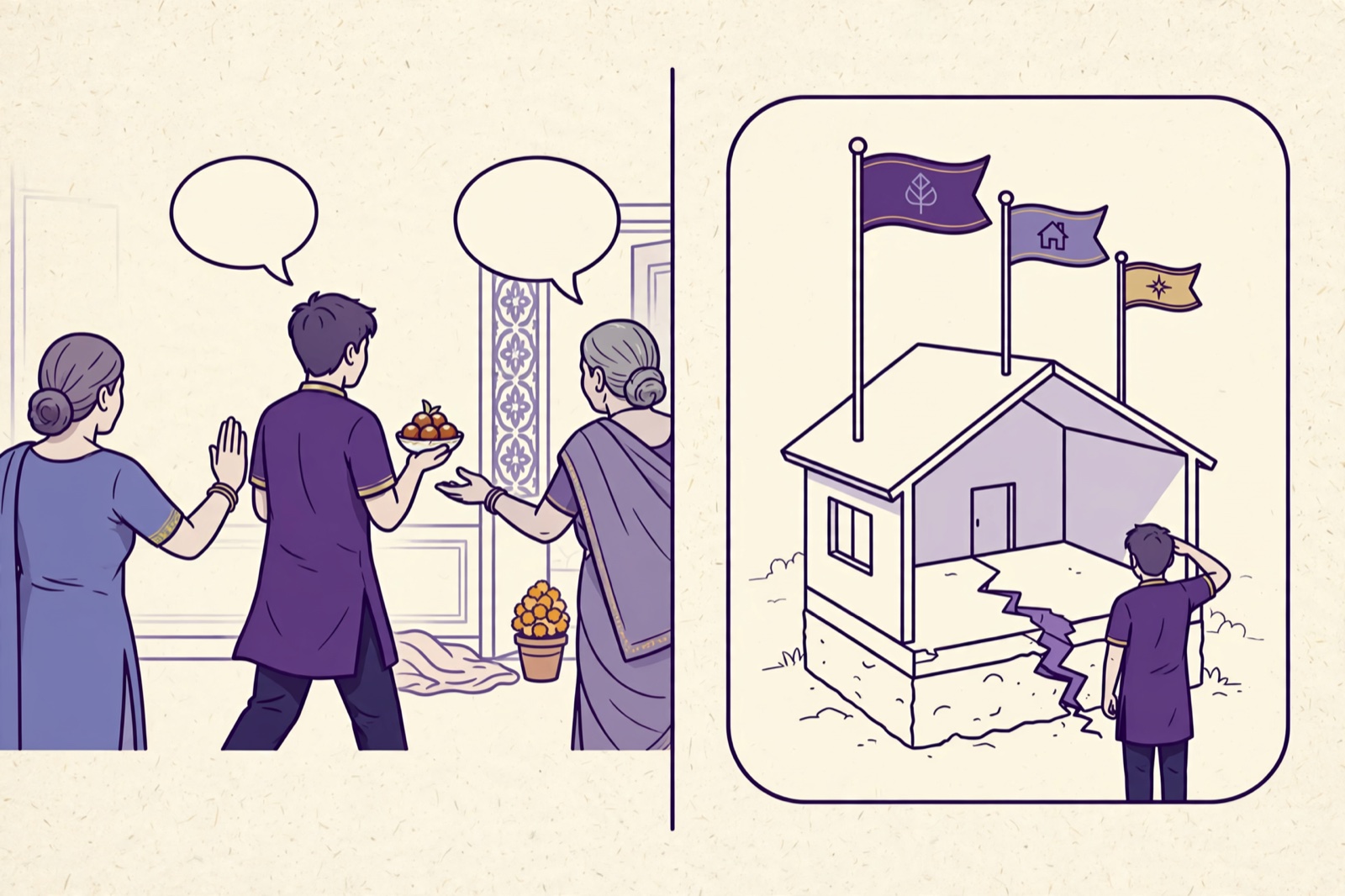
"Meanwhile your teen has learned the most valuable lesson of his year: there are three governments in this house, and grandma's always wins."
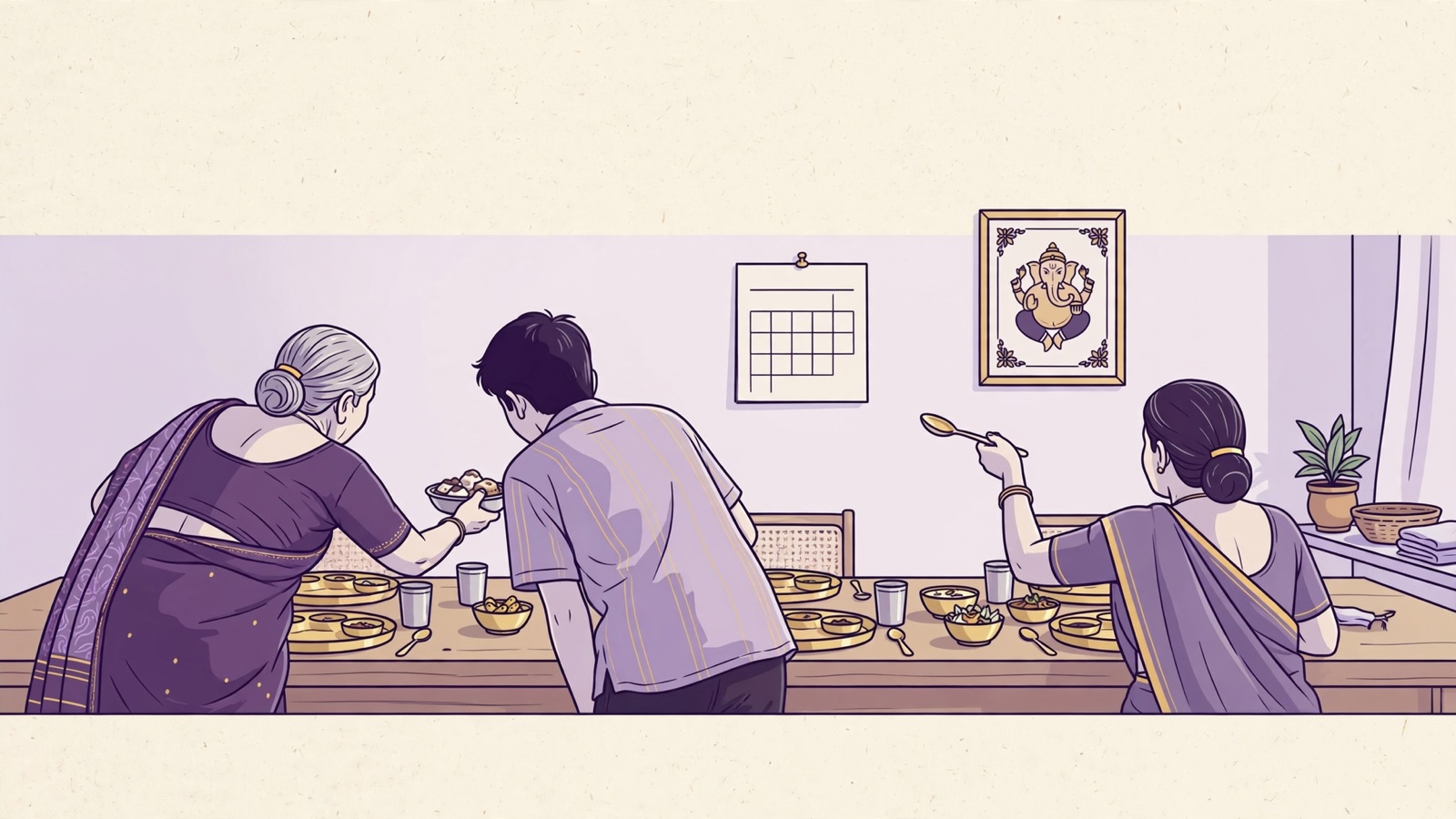
This isn't a modernity-vs-tradition war and Dadi isn't your enemy — she's a second legislature that was never merged. Joint families ran on elder authority for generations; your parenting rules are the new amendment that was never ratified. Ratify it — with respect, not revolt — and the extra counter becomes your strongest ally.
The Behavior Decoder
Translating what you see into what their nervous system is actually experiencing
"'Dadi said I could!' — deployed with visible triumph after your no"
Three governments, and I just discovered which one has no enforcement. Why would I obey the strict one when the soft one overrules?
"Elder openly contradicts you: 'In our time children respected automatically. You're too soft/strict.' Plus unsolicited methods"
Elders experience your boundaries as a verdict on their parenting — every new rule implies the old way was wrong.
"Teen weaponises elder affection: performs devotion to Dadi precisely when you've set a limit"
Grandma's lap is the one place no rule reaches. Clinging there isn't love, it's asylum-seeking — and it works every time.
Hierarchy Collision: Two Authority Systems, One Child

Joint families run two legitimate authority systems simultaneously: age-hierarchy (elders decide) and parental-responsibility (parents decide). For most of history these agreed, because parents were young and deferred upward. Modern parenting — with its boundaries, psychology, and negotiated rules — creates the first systemic collision: the people legally and morally responsible for outcomes (you) lack final authority, while the people with final authority (elders) don't carry the outcomes. The teen's brain resolves the contradiction the efficient way: obey whoever is softest in the moment. Loyalty splits, authority fragments, and everyone blames the teen's 'manipulation' for what is really constitutional design failure.
Natural Instincts That Accidentally Make It Worse
Every caring parent falls into these traps out of love, fear, or exhaustion. Here is what happens inside their nervous system and how to shift:
The Nuclear Option (Separate or Else)
'Either they stop interfering or we move out!' — ultimatums about the household itself.
Forces loyalties into open war, usually loses (economics, culture, guilt), and teaches the teen that family problems get solved by exit threats.
Downgrade the demand from structural to procedural: not 'move out', but 'one weekly alignment chai where we agree the week's lines together.'
Public Correction of Elders
Overruling Dadi in front of everyone to 'show who decides now.'
Wins the moment, loses the war: humiliated elders retaliate through indulgence, and the teen learns authority is performance, not institution.
Absolute rule: support elders publicly, always. Disagreements travel upward privately — 'Ma, can we align on the phone rule after dinner?'
Affection Competition
Out-gifting, out-indulging Dadi, or subtly running her down: 'Dadi lets you because she doesn't know better.'
Puts the teen in a loyalty bind that breeds anxiety, and guarantees the elder doubles down — nobody surrenders a grandchild quietly.
Refuse the contest entirely. Your currency is structure and future; hers is warmth and present. Different economies, no exchange rate needed.
The Extended Merger Protocol
Bring the elders into the legislature with honour intact — ally, not rival.
Honour First, Rules Second
Open every alignment conversation with genuine acknowledgement.
- Name her contribution specifically and often: 'Ma, the values in this house — the honesty, the food discipline — that's your decades of work. We're building on it, not replacing it.'
- Ask for stories, not permission: 'How did you handle late nights when Papa was fifteen?' — elders who feel consulted stop feeling bypassed.
- Never open with the complaint. The rule discussion comes after the honour deposit, every single time.
The Weekly Alignment Chai
One short private ritual that replaces all ambush corrections.
- Fifteen minutes weekly, parents + key elder, teen elsewhere: this week's lines (sleep, screens, study), who enforces what, where flexibility lives.
- Give elders owned territory: Dadi owns storytelling hour, festival prep, food traditions — real authority where it matters, not veto rights over bedtime.
- Write the week's three lines on the fridge — unsigned, institutional. 'House rules', not 'bahu's rules.'
The Deferral Phrase, Extended Edition
Give elders the same pressure-valve you give your spouse.
- Agree the line: 'Let me check with his mother/father first — house rule.' Elders use it when the teen shops upward; it protects their dignity while holding the line.
- Frame it as respect-preservation: 'This way you never have to be the bad guy, Ma — the rule does that job.'
- Back it every time: when Dadi defers, praise it later privately. Reinforced behaviour repeats.
Give the Teen One Clean Channel
End the multi-counter shopping with a single visible process.
- Announce the merger to him directly: 'From Sunday, all permissions go through Mum and Dad first — Dadi's been asked to redirect you to us. Not punishment; just one counter now.'
- Expect the extinction burst aimed at Dadi (week one, maximum drama at her door). Warn her in advance so she holds.
- Reward the new pattern: when he comes to you first, decide fast and warmly. The single counter must also be the faster counter.
What to Say Tonight: Word-for-Word Scripts
Save these to your phone or keep them in mind for your next interaction.
"(Warmly, publicly:) 'Ma's right that he's tired — long day.' (Later, privately:) 'Ma, when the rule bends in front of him, my no stops working everywhere. Next time, could you send him to me with a let me check with your mother? Then you're never the villain and the rule holds.'"
Public grace, private candour. Never the reverse.
Protects her face in the moment (alliance preserved), then recruits her with a face-saving mechanism that costs her nothing.
"'Ma, fifteen minutes — this week's plan. Sleep by eleven, screens docked at ten, tuition homework before play. Where would you keep flexibility? And I'll hold the enforcement so you never have to be strict — that's my job, not yours.'"
Consultative, pen in hand, genuinely listening on the flexibility question.
Assigns her the honoured role (flexibility-granter) while quietly centralising enforcement with you. She gains status; you gain the gavel.
"'Dadi loves you, and house permissions come through us first now — that's the new system for everyone. Let's ask together: come, we'll check with her right now what the week's rule is.'"
Unthreatened, procedural. Walk WITH him, don't send him.
Refuses the arbitrage without villainising Dadi, and the joint check converts the shopping trip into a merger demonstration.
Recruit, don't revolt: honour first, rules second, merger always.
Public grace, private candour
"Support elders publicly, always. Disagree privately, weekly. One counter for the teen."
The Underlying Psychological Mechanics
Why Elders Undermine (It's Rarely Malice)
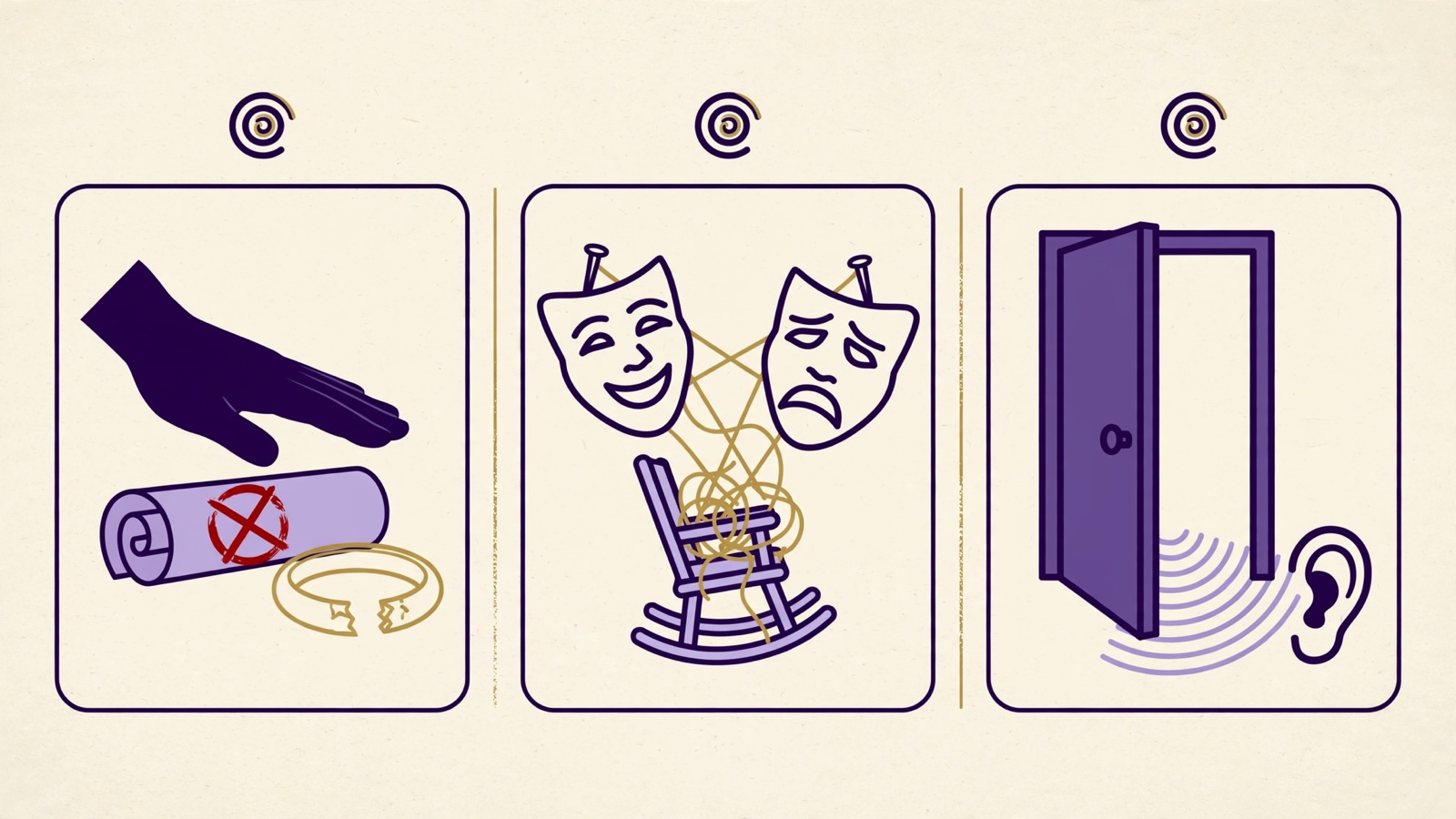
All three yield to the same solvent: honour + owned territory + a face-saving deferral mechanism. Attack any of the three directly ('you're spoiling him', 'stay out of parenting') and all three harden. The merger works because it never asks elders to matter less — only to matter differently.
The Couple Must Merge First
Nuclear Families Aren't Exempt
All Situations in Parenting Styles, Boundaries & Spousal Alignment
Connect Before You Direct (The Golden Rule)
Why barking commands triggers biological resistance, and how a 2-minute connection ritual unlocks voluntary cooperation.
Anger Isn't the Problem — Reactivity Is
How to harness anger constructively to hold firm boundaries without shouting, sarcasm, or silent treatments.
When Spouses Disagree: Ending Good Cop / Bad Cop
How divided parental rules cause teens to manipulate boundaries, and how to create a unified front behind closed doors.
Natural Consequences vs. Damaging Punishment
Why taking phones away creates hostility, and how to use non-damaging consequences that teach true accountability.
When In-Laws & Extended Family Interfere
Protecting household boundaries from generational guilt, comparisons, and unsolicited parenting advice.
Never Withdraw Love: Why the Silent Treatment Damages Adolescents
Cold wars feel like consequences to you and abandonment to them — stay present during the fight.
Don't Try to Fix Everything Tonight. Just Start Here.
Parenting shifts happen in tiny, consistent micro-moments. Choose the resource that fits your immediate need:
The Single-Counter Rulebook Template (Printable)
Ten-rule template with the elder-edition deferral phrase and the weekly alignment chai agenda.
Discover Your Parenting Style & Reactive Triggers
Answer 6 quick questions to discover the exact root driver behind your teen's specific behavior patterns.
The Steady Parent
Work 1-on-1 to reset your home environment, resolve chronic conflicts, and build lasting connection.
Cross-Chapter Recommended Guides
Ending Good Cop / Bad Cop: When You and Your Spouse Parent From Opposite Trenches
Good cop / bad cop isn't a style difference — it's a structural crack your teen arbitrages daily. Learn the closed-door alignment protocol: disagree in private, present one front, and retire both uniforms.
Connect Before You Direct: The Golden Rule of Adolescent Cooperation
Commands without connection feel like threats to an adolescent's developing autonomy. Discover the 2-minute rapport protocol that ends morning screaming matches and evening homework battles.