
Board Exams, Academic Pressure & ADHD
The Exam Panic Teen: When Test Mornings Bring Nausea and Dread
Physical sickness before tests, blanking out in the exam hall, and spiraling 'what if I fail' dread — the panic circuit and the regulation script that resets test day.
Unconditional Regard
The fear that parental warmth, respect, and love are conditional on academic or behavioral performance.
The Morning Illness Investigation
Mystery-medicine routines validate the fear and teach every exam to produce the same escape route.
"Your stomach is doing panic, not illness. Breathe with me — three, together."
"It's 6:40 AM on exam day. He's sitting at the breakfast table with an untouched plate of upma, one hand pressed to his stomach."
"'Ma, I feel like throwing up. It's the same kind of stomach pain as the last two exams.' The doctor found nothing. The half-shut school bag sits abandoned near the door because he couldn't face a last revision chapter at 7 AM."
"Ninety minutes later you get the call from school: he took one look at the physics paper, put his hands over his eyes, and left the hall after twenty minutes of just sitting there."
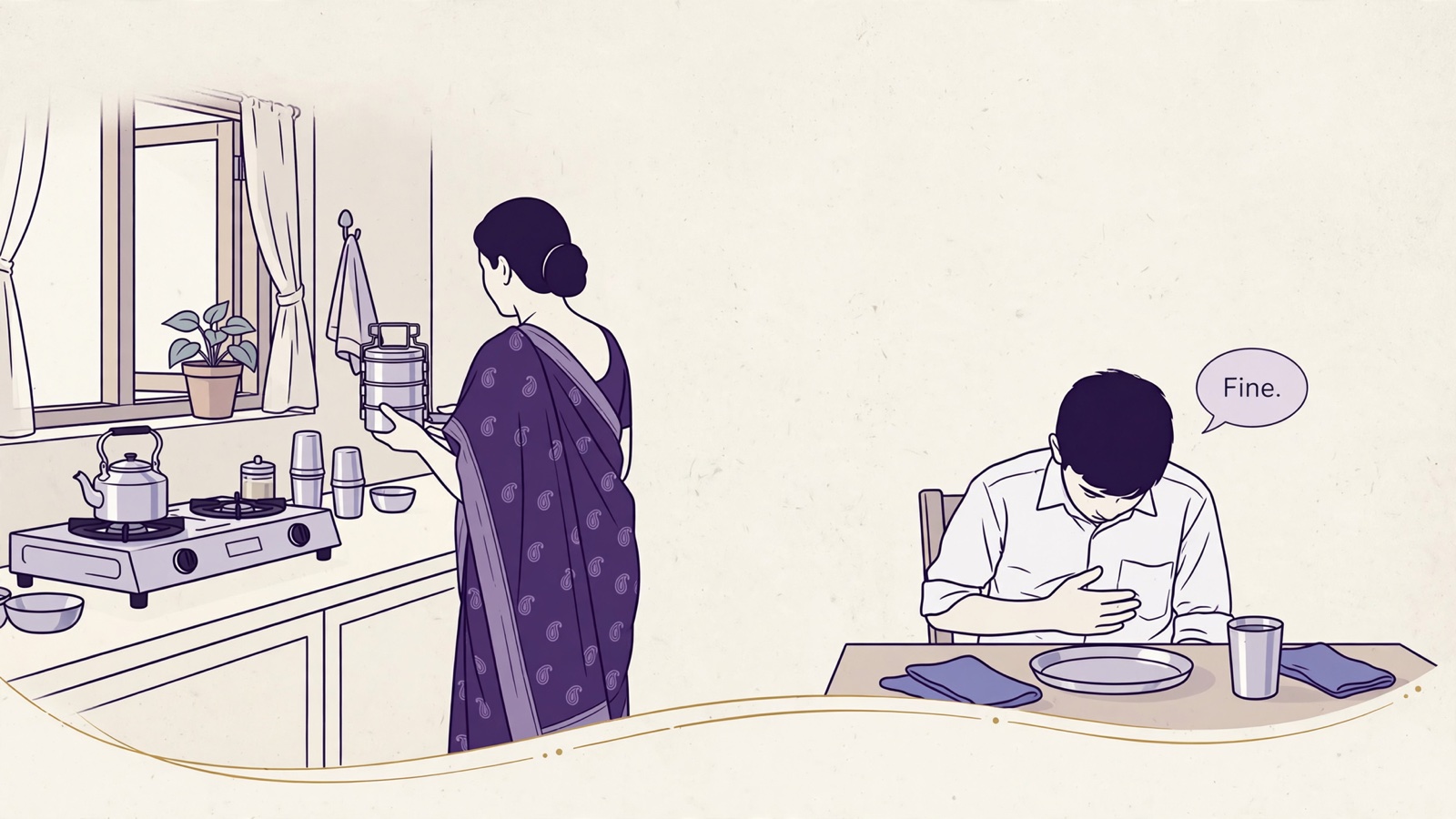
You are not raising a weak child, and the school call is not a discipline problem. Exam panic lives in the body — nausea, headache, breathlessness, blanking — because a real alarm system has been wrongly calibrated to the exam hall. Recalibrating that alarm is teachable, and it does not start with 'you'll be fine'.
The Behavior Decoder
Translating what you see into what their nervous system is actually experiencing
"'I can't go today. My stomach really hurts.' (Third time this month)"
My body physically ramps up panic — racing heart, churning gut — hours before the exam. Avoiding the exam hall is the only off-switch I know.
"(Sits for twenty minutes, writes almost nothing, hands in a near-blank paper)"
The first page's difficulty triggered a full freeze. My working memory is hijacked by threat, not by lack of knowledge.
"'What if I fail and have to repeat the year? We can't afford coaching fees again...'"
I have cycled this catastrophe a hundred times tonight — racing thoughts at 2 AM about an exam still days away.
The Alarm Without an Off-Switch (Amygdala Hijack and Physical Panic)
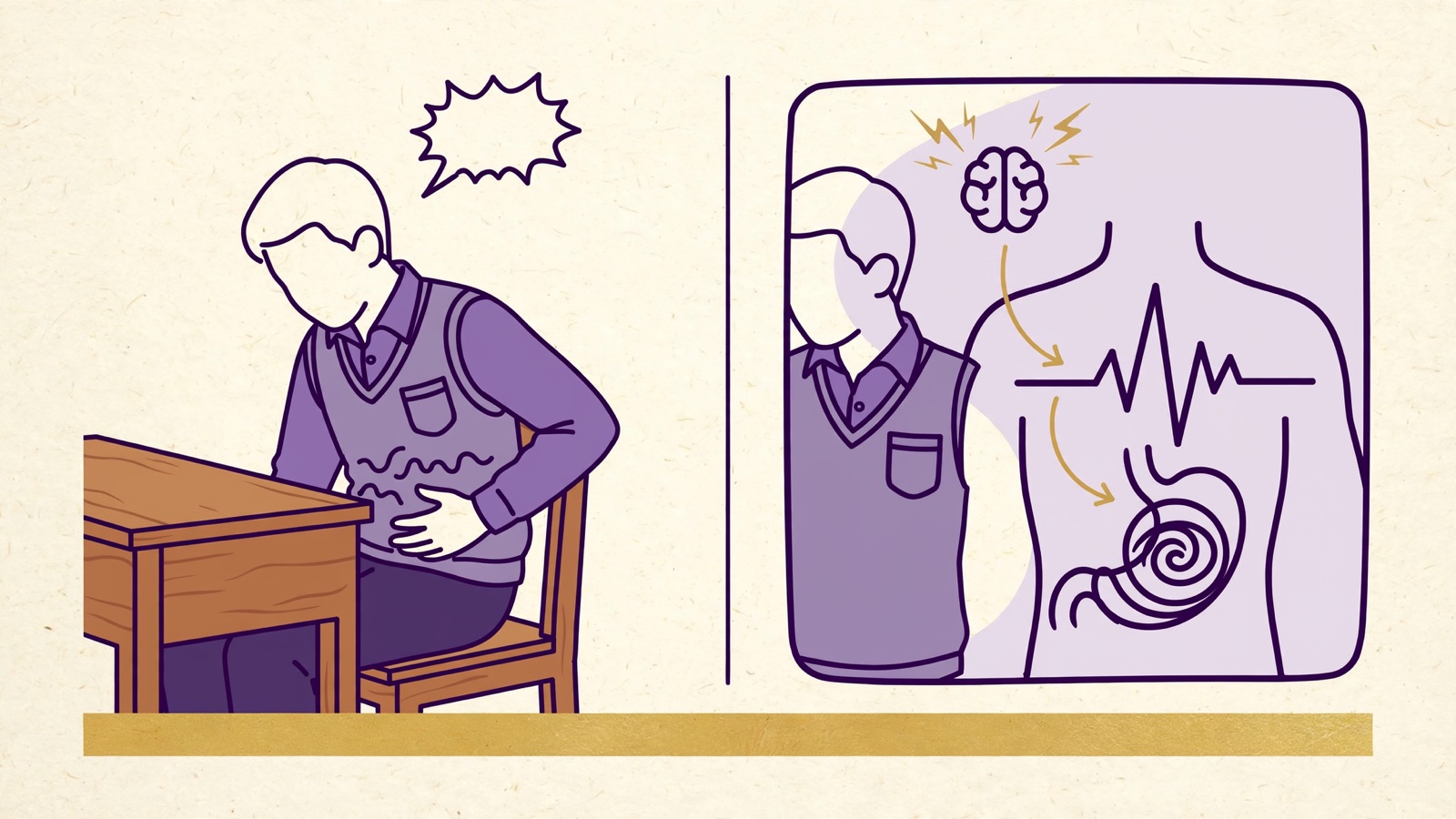
Test-day panic is a threat response misplaced onto an exam hall. In a nervous system trained to treat ranks as safety, the amygdala fires early — sometimes days before the paper — triggering the same physical cascade as real danger: gut contractions, shallow breathing, adrenaline. Working memory runs on the prefrontal cortex, which the panic signal shuts down first. That's why a well-prepared student can stare at a page and recall nothing — the knowledge isn't missing, it's locked behind the alarm. Regulation first, retrieval second, in that order.
Natural Instincts That Accidentally Make It Worse
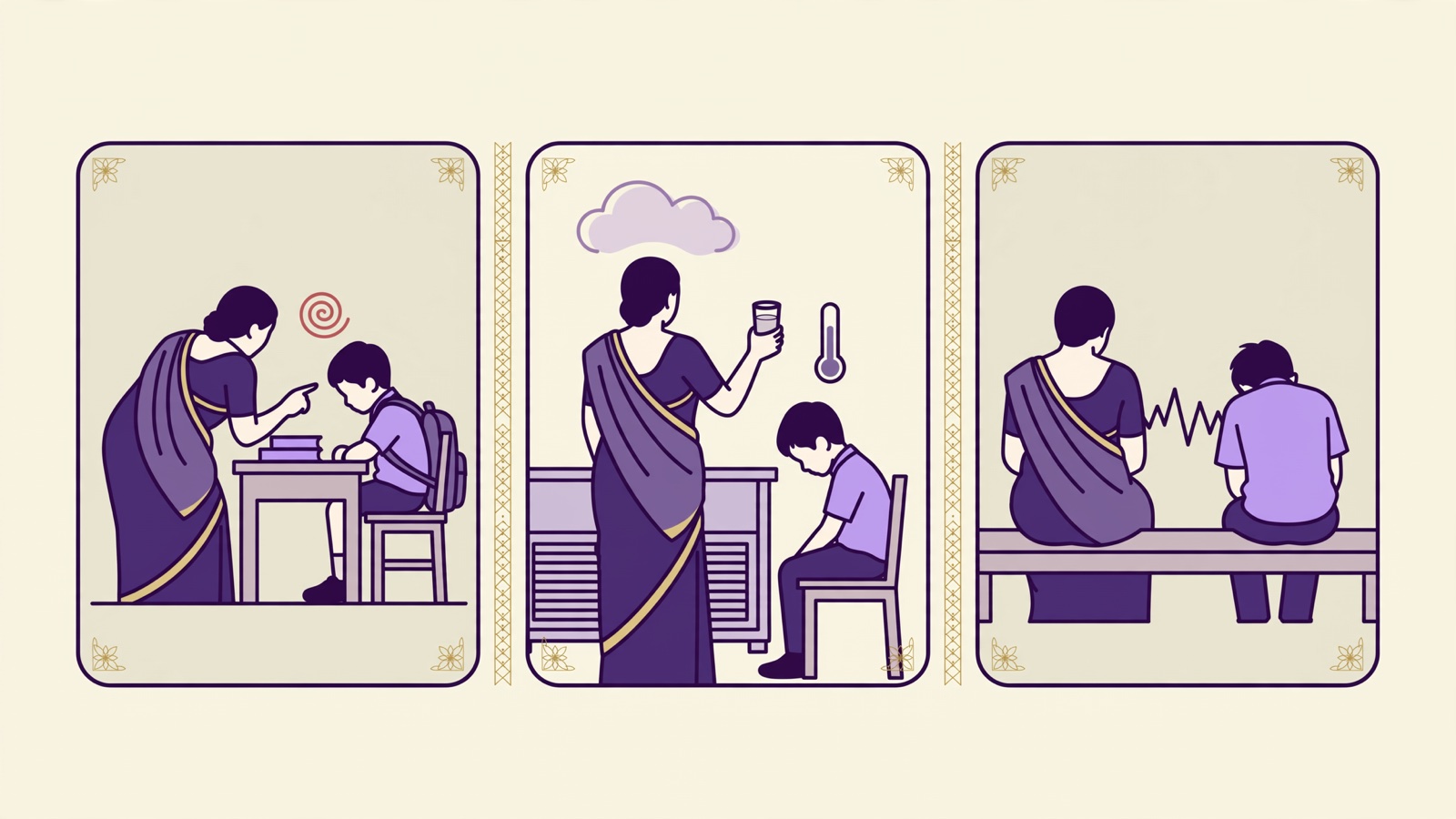
Every caring parent falls into these traps out of love, fear, or exhaustion. Here is what happens inside their nervous system and how to shift:
The Performance-Pressure Reassurance
'Why panic? You know the whole syllabus. Just go and write what you know.'
Restates the stakes — 'this matters and your knowledge is expected' — precisely when their body needs the stakes lowered.
Lower the stakes consciously: 'This paper cannot change how this home runs or how much you are loved. Let's just get through the next three hours.'
The Mini Medical Investigation
Googling symptoms, offering special drinks at 7 AM, or grilling them about what exactly hurts.
Reinforces that the stomach is the problem, so every subsequent exam manufactures the same escape route.
Name it gently once: 'Your stomach is doing panic, not illness. Your body is allowed to feel scared before big days — and it doesn't have to win.'
The Post-Exam Interrogation
In the car immediately after: 'How was it? How many questions did you attempt?'
Attaches surveillance to the exact hours their nervous system most needs decompression. Next exam, the panic starts a week earlier.
The first hour after any exam is no-question time: food, quiet, ordinary conversation about anything except the paper.
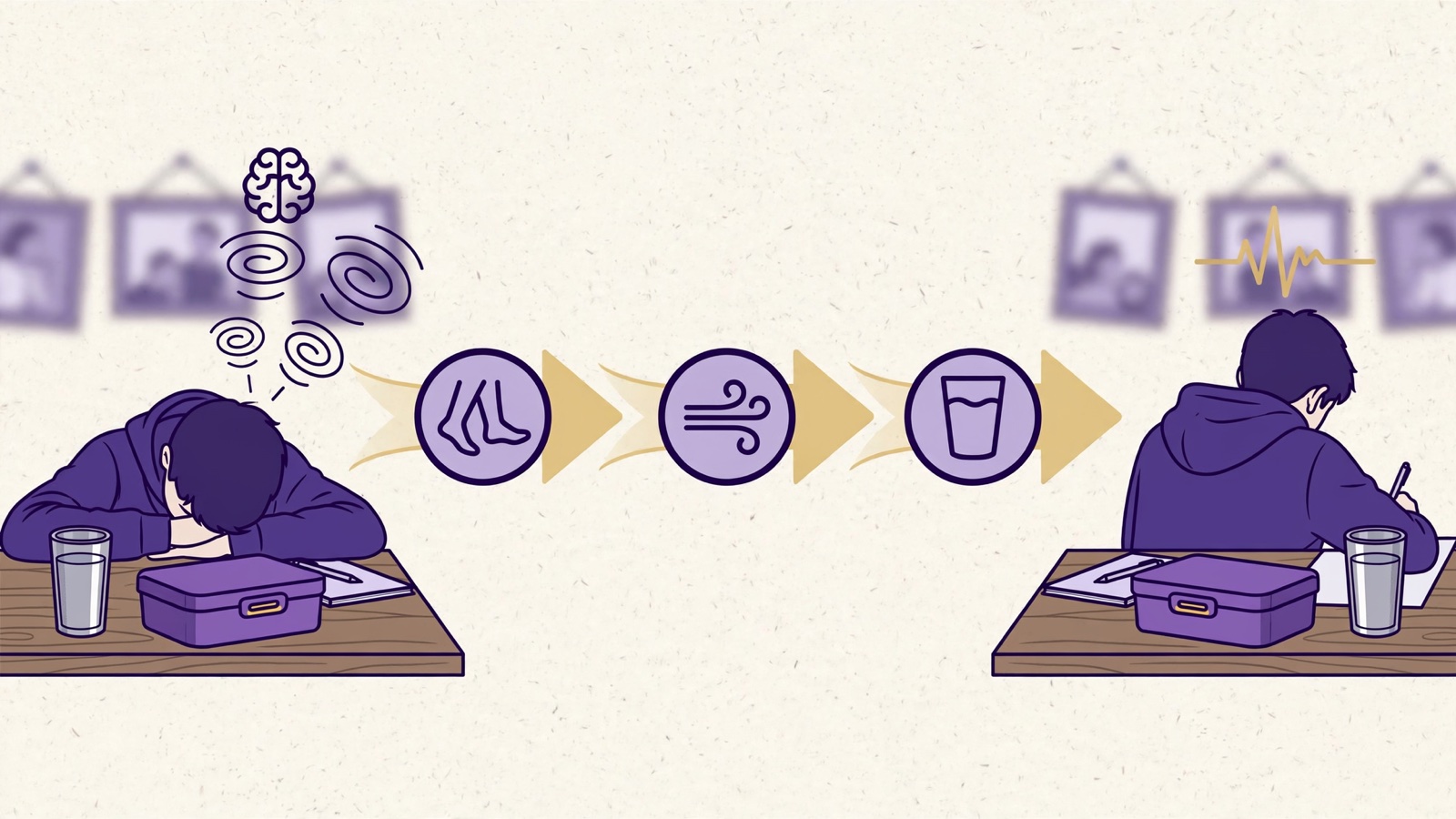
The 3-Legged Regulation Protocol (Body, Breath, Brain)
Run this before, during, and after the next exam — it rebuilds the panic-response habit rather than managing one morning.
The Body Leg: Regulate Before You Reason
Panic is physiological — attack it with physiology first.
- Night before and morning of: a fixed 15-minute walk, a regular dinner, and a relaxed alarm margin — no 6:15 AM mad rush.
- On exam morning: three rounds of 4-7-8 breathing (inhale 4, hold 7, exhale 8) plus a large glass of water — the vagal brake shifts in under two minutes.
- Eat something small and familiar even if nausea persists — an empty stomach amplifies adrenaline.
The Breath Leg: The Exam-Hall First Five Minutes
Give them a concrete protocol for the moment panic hits inside the hall.
- Read the whole paper once without answering anything — scanning before solving defuses the freeze trigger of 'I don't know any of these'.
- Start with the easiest question first, even the tiniest one — retrieving one answer restarts working memory.
- If blank: feet flat, long exhale, press both palms into the desk for five seconds, then return to the easiest item. Blanking one section costs minutes; blanking the whole paper costs the year.
The Brain Leg: Rewire the Catastrophe Loop
Replace night-loop catastrophes with a written, bounded reality check — two minutes, next day.
- Never debate a catastrophe at 10:30 PM. Say: 'We'll park this thought for tomorrow's two-minute review.'
- The next evening, walk through it for fifteen minutes only: realistically, what happens if this goes badly? Usually the honest answer is 'a retake or a lower college — survivable', not 'life over'.
- Say once, plainly: 'There is no score you can bring home that will change how this family treats you.'
What to Say Tonight: Word-for-Word Scripts
Save these to your phone or keep them in mind for your next interaction.
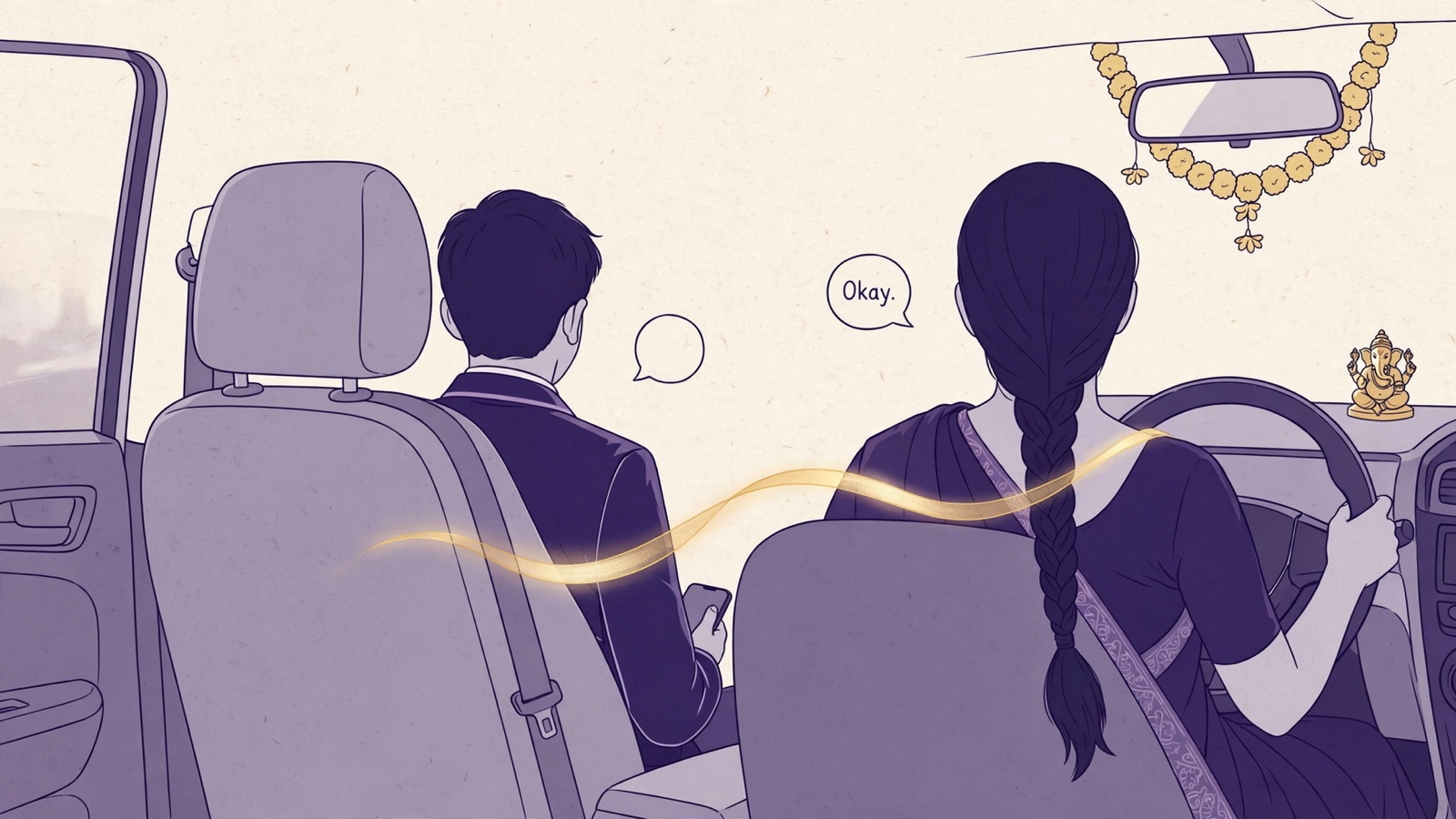
"'Your stomach is doing panic, not illness — I know it feels exactly like a sickness. A scared stomach needs a steady parent, not a diagnosis. Breathe with me three times, and we'll get through today in three-hour pieces.'"
Calm, unhurried, eye-level beside them, not towered over. Hand on shoulder, not on their bag.
Names the mechanism without dismissal, models regulation as a shared technique, and fragments dread into a survivable block.
"'That's a catastrophe question, and catastrophe questions get parked after 10 PM. I hear how heavy it feels. We'll take it up tomorrow for two minutes — and I promise we'll find the survivable version together. For now: chai, or a short walk?'"
Soft, seated side-by-side (car, sofa, kitchen bench). Zero lecture energy.
Validates the fear without feeding it, gives it a bounded appointment time, and moves the body toward regulation instead of another loop.
"'You walked into that hall with a panic attack and still faced the paper. That part took real courage, and I'm proud of it — whatever the marks say. Lunch first. No paper talk for the next hour.'"
Warm, low voice, no follow-up questions until much later.
Rewards courage rather than performance, prevents the interrogation reflex, and keeps the recovery window safe.
Regulate the body first, reason with the brain second.
Calm, unhurried, eye-level beside them, not towered over
"Your stomach is doing panic, not illness. Breathe with me — three, together."
The Underlying Psychological Mechanics
Why Exam Panic Looks Like a Stomach Ache
That is why panic arrives as body symptoms before thought: nausea, headache, breathlessness, a racing heart, and the signature freeze where knowledge can't be retrieved. No amount of logical reassurance — 'you know the syllabus' — touches a physical alarm.
The correct entry point is regulation, not reasoning: breath work, walking, warmth, a plan in fragments. Retrieval becomes possible again only after the body steps down.
The Family Feedback Loop Parents Miss
The counter-loop is deliberately boring: predictable dinners, relaxed margins in timing, one identical quiet sentence after every result, good or bad. Predictability is what a panic-calibrated brain is actually asking for.
When to Escalate Beyond a Parent
All Situations in Board Exams, Academic Pressure & ADHD
The Perfectionist Spiral (Crying Over 93%)
Terrified of making any mistake, chronic self-criticism, and tying their entire self-worth to report cards.
The Exam Panic & Physical Nausea Spiral
Physical sickness on test mornings, spiraling future dread, and test-taking paralysis.
Failing Grades & Academic Surrender
When marks drop, confidence collapses into 'I don't care anyway', and they give up on studying.
ADHD, Executive Lag & The Scattered Backpack
Lost books, chronic dopamine hunting, and why conventional nagging about homework never works.
Sensory Overwhelm & Social Masking Burnout
Exhaustion after school, sensory meltdowns at home, and navigating high-pressure environments.
Board Exam Season Survival (Class 10 & 12)
Three months of mock-test weather: how to be the calm parent the exam hall never provides.
Don't Try to Fix Everything Tonight. Just Start Here.
Parenting shifts happen in tiny, consistent micro-moments. Choose the resource that fits your immediate need:
The 5-Minute Exam Panic Reset (Printable)
A 1-page before-test nervous-system reset — breath protocol, paper-scanning moves, and the exam-hall recovery drill.
Test Your Teen's Performance Anxiety Score
Answer 6 quick questions to discover the exact root driver behind your teen's specific behavior patterns.
Exam Calm
Work 1-on-1 to reset your home environment, resolve chronic conflicts, and build lasting connection.
Cross-Chapter Recommended Guides
The Perfectionist Teen: Ending the Spiral of Self-Doubt and Panic Over 93% Marks
When 93% feels like a failure and a minor mistake brings tears of devastation, your teen isn't being ungrateful — they are trapped in a fragile self-worth loop. Learn how to decouple their dignity from test marks.
The Surrendered Student: When Failing Grades Turn Into 'I Don't Care Anyway'
'I don't care anyway' is almost never the truth — it is armour against a grade line they believe is unwinnable. Learn to drop the fight over effort and rebuild competence one reachable rung at a time.